Countries are clamoring to join BRICS group, South Africa says, as Russia takes up leadership

Nearly three dozen countries are seeking entry into the China and Russia-backed BRICS economic group, member state South Africa said Wednesday, weeks after the body expanded its membership for the first time in more than a decade.

Thirty-four countries have submitted an expression of interest in joining the bloc of major emerging economies, South African Foreign Minister Naledi Pandor told reporters, without naming the nations.

Russia was accepting those applications after assuming rotating chairmanship of the group this year – and will be the first member to oversee the body since it significantly expanded its global footprint at the start of the year, when Iran, Saudi Arabia, the United Arab Emirates (UAE), Ethiopia, and Egypt formally joined.

The growing membership is widely viewed as a win for China and Russia, which have sought to reshape an international system they see as unfairly dominated by the United States amid growing frictions with Washington and the West.

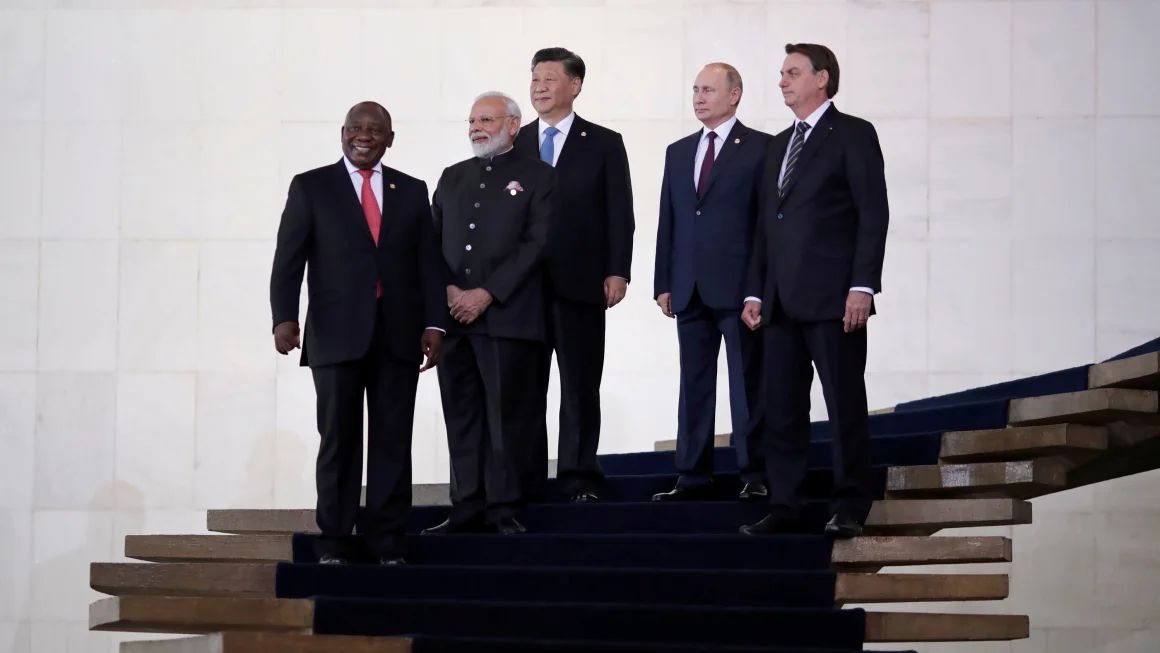
BRICS, which since 2011 had been made up of Brazil, Russia, India, China and South Africa, roughly positions itself as the Global South’s answer to the Group of Seven (G7) major developed economies.

China has been a key driver of its expansion as leader Xi Jinping pushes an alternative world order, forging closer partnerships with key global players from Russia to the Middle East and strengthening international bodies where Beijing holds sway.

The expansion and continued interest from dozens more countries are also a boon for Russia, which has been shunned economically and diplomatically by the West following its invasion of Ukraine.

Moscow’s position as chair will be a key opportunity for Russian President Vladimir Putin to push back against that isolation and portray himself as a key player on a broad diplomatic stage, as world leaders typically travel to the host nation for an annual summit.

Last year, all member state leaders besides Putin gathered in person in Johannesburg. The Russian president, who has an International Criminal Court warrant out for his arrest linked to alleged war crimes in Ukraine, participated virtually.

This year’s event is expected to take place in October in the southwestern Russian city of Kazan.

Earlier this year, Putin encouraged representatives “of all countries interested in cooperating with our organization” to take part in events and said Russia looked forward to “working productively with all countries in the BRICS orbit,” according to state-run news agency Tass.

The group took shape as a summit-level gathering between Brazil, Russia, India and China in 2009 and expanded to include South Africa two years later.

Six new BRICS countries were invited during the 2023 summit last August. Among those invited only Argentina declined to join, following the election of a new far-right administration.

The expansion adds the muscle of major oil-producing Gulf economies to the body and comes as both Russia and China have bolstered their relationships with sanctions-hit Iran. Last year, Beijing played a part brokering the restoration of ties between longtime rivals Saudi Arabia and Iran.

The new cohort of countries join as BRICS pushes toward more diplomatic and financial coordination, including reform of the United Nations Security Council and a move away from a US dollar-dominated trade system.

Finance ministers were working to develop the use of local currencies for payments between member states and international payment platforms to “redress what we regard as a rather unfair and costly payment system,” South Africa’s Pandor said Wednesday.


Saudi Arabia has not yet joined BRICS – Saudi official source

Saudi Arabia is still considering an invitation to become a member of the BRICS bloc of countries after being asked to join by the group last year, a Saudi official source told Reuters.

The source commented after South Africa’s Foreign Minister Naledi Pandor said on Wednesday the kingdom had joined the grouping.

“Saudi Arabia has not yet responded to the invitation to join BRICS. It is still under consideration,” the Saudi official source said in a statement to Reuters.

The group in August invited Saudi Arabia, the United Arab Emirates, Egypt, Iran, Argentina and Ethiopia to join from Jan. 1, although Argentina signalled it would not take up the invitation in November.

The expansion of the BRICS group, whose current members are Brazil, Russia, India, China and South Africa, would give it additional economic heft and could also boost its declared ambition to become a champion of the Global South, helping reshuffle a world order it views as outdated.

Faisal Alibrahim, Saudi Arabia’s economy minister, earlier this month said the kingdom was still looking into the matter.

Riyadh is weighing its options against a backdrop of rising geopolitical tensions between the United States, China and Russia, and as the kingdom’s warming ties with Beijing have caused concern in Washington.

Fellow Gulf Cooperation Council (GCC) member the UAE United Arab Emirates has said it had joined the bloc.

BRICS Women’s Forum in 2024 will be held for the first time in the framework of the Eurasian Forum

The BRICS Women’s Forum will be held for the first time on the margins of the Fourth Eurasian Women’s Forum scheduled from 18 to 20 September in St. Petersburg. This was announced by Valentina Matvienko, Chairwoman of the Council of Federation (FC), at a meeting of the organising committee of the upcoming women’s forum. She recalled that this year Russia is leading BRICS.

“At this BRICS Women’s Forum, both the results of existing projects and new initiatives will be presented, which will strengthen partnerships between the BRICS member countries, including on the women’s agenda” Valentina Matvienko, Chairwoman of the Council of Federation

The Speaker stressed the need to pay special attention to the concept and organisation of the forum as an important BRICS event. Matvienko also named the preliminary theme of the upcoming event: “Women for Confidence Building and Global Cooperation”. She added that the organisers expect a broad representation of countries from the global South and East. This is reported by TASS.

According to the Speaker of the Upper House of Parliament, women leaders from all over the world have something to say on the announced theme. In order to ensure the fullest possible participation of all those wishing to participate, the widest possible application campaign should be organised, Matvienko said. The most authoritative speakers should be invited to the forum.

In turn, First Deputy Minister of Labour and Social Protection of the Russian Federation Olga Batalina said that the programme of this major event will traditionally begin several months in advance with a number of regional industry events. She added that the Ministry of Labour plans to hold several BRICS events in Moscow, Kazan and Sochi.

News Credit: https://tvbrics.com/en/news/brics-women-s-forum-in-2024-will-be-held-for-the-first-time-in-the-framework-of-the-eurasian-forum/

Russia’s BRICS Sherpa names the priority areas of cooperation in the year of Russia’s chairmanship in the group

The first day of the BRICS Sherpas and Sous-Sherpas meeting, organised by Russia as the group’s chairman, was held in Moscow. Representatives of the five new members of the association: Egypt, Iran, UAE, Saudi Arabia, Ethiopia and Egypt are taking part in it for the first time.

One of the priorities of BRICS activities in 2024, Russia declared harmonious inclusion of the debutants in the common work. Now these plans are being put into practice. Traditionally, the Sherpas gather to reconcile positions on the main international areas, discuss pressing issues of cooperation and prepare for upcoming events.

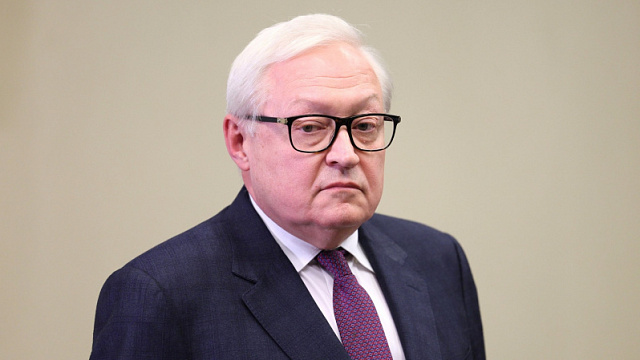
Opening the meeting Russia’s Sherpa for BRICS and Deputy Foreign Minister Sergey Ryabkov, noted that the expansion of the alliance will benefit every member state of the group. In addition, the move contributes to building a fairer multipolar world order.

He also emphasised that the accession of new countries will strengthen the role of emerging market states in the global decision-making process.

In addition, the Russian BRICS Sherpa spoke about the priorities of the Russian BRICS chairmanship for this year. According to him, the focus will be on the development of economic ties in BRICS.

“In line with the decision of the BRICS leaders in Johannesburg, we will explore ways to make greater use of national and local currencies and payment instruments in our cross-border transactions in order to reduce the negative side effects of the current global economic system” – Sergey Ryabkov Russia’s Sherpa for BRICS

For his part, China’s BRICS Sherpa Ma Zhaoxu said the PRC believes it is necessary to use national currencies in settlements between countries.

“We should strengthen our practical cooperation, support the active work and promote the development of the BRICS New Development Bank (NDB),” Zhaoxu said.

According to him, the authorities are also considering launching a BRICS centre for cooperation in the development of artificial intelligence technologies. This area of work of the BRICS states is becoming one of the most important within the group.

Mehdi Safari, Iran’s BRICS Sherpa, expressed his agreement with his Chinese counterpart. He noted that Tehran also expects to intensify the transition to settlements in national currencies during Russia’s presidency in the alliance.

Another important topic is co-operation between the member countries in the health sector. Abhishek Singh, India’s Foreign Ministry representative and the country’s Sherpa in the alliance, made a proposal to set up a BRICS common depository of medicines. He also said India plans to make progress on the BRICS online database archive project in 2024.

“Such an archive will be a great opportunity to access authentic BRICS documents,” Abhishek Singh explained.

During the meeting, Egyptian Deputy Foreign Minister Ragui El-Etreby expressed the country’s readiness to be active in everything related to the development of ties in the areas of trade, information and communication technologies, maritime transport and logistics. In addition, Egypt looks forward to Russia’s assistance as BRICS chair in addressing food and energy insecurity.

“We are well aware that smooth integration and full inclusion of new members in the work of BRICS is a major step. But we are confident that under your able leadership we will be able to successfully address each of these challenges,” Ragui El-Etreby said.

Speaking at the meeting, Ahmed Al Badawi of the UAE Foreign Ministry said that the United Arab Emirates intends to share its experience in the digital economy with its colleagues. According to him, such interaction will help achieve the BRICS digital transformation goals.

South Africa’s Sherpa Anil Sooklal said there has been a manifold increase in interest in the association from most of the developed countries and states of the global North.

“We think it shows a confidence in what the association is doing, the principles we profess and the goals we have set for ourselves. It shows that we are moving in the right direction” Anil Sooklal, South Africa’s Sherpa

Ana Maria Bierrenbach, Brazil’s sous-sherpa to BRICS, spoke about the achievements in co-operation among the bloc’s countries last year under the South African presidency: “In 2023, more than 200 events were held. Thanks to these meetings, we have made serious progress in science, technology, health.” Birrenbach noted that one of the major decisions of last year was the accession of new members.

Ethiopia’s Sherpa to BRICS, Mamo Mihretu, has expressed his country’s support for the Russian chairmanship of the group.

“The Russian chairmanship will increase the influence of our association. We are grateful to have been briefed on a number of projects. This will allow for greater integration of the new member states of the group. We are convinced that the expansion of membership will open a new page in our multilateral partnership,” he emphasised.

Recall that on 1 January 2024, five new states Egypt, Iran, UAE, Saudi Arabia and Ethiopia joined BRICS. Russia is chairing the bloc this year.

News Credit: https://tvbrics.com/en/news/russia-s-brics-sherpa-names-the-priority-areas-of-cooperation-in-the-year-of-russia-s-chairmanship-i/

Amb. Muktar Confers With Chair Of South African BRICS Youth Association

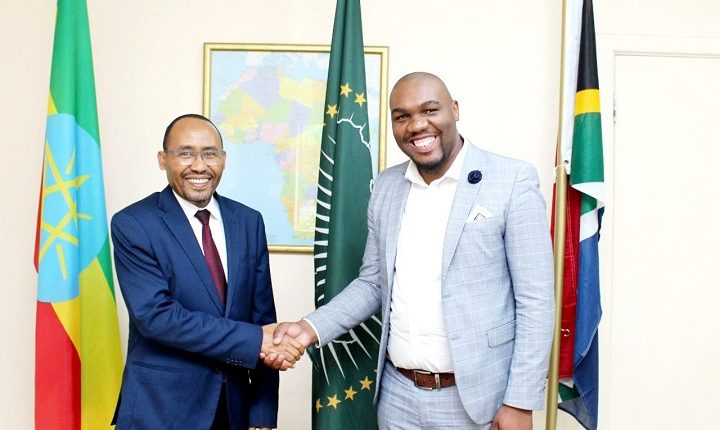
Addis Ababa, November 13, 2023 (FBC) – Muktar Kedir, Ambassador Extraordinary and Plenipotentiary of the Federal Democratic Republic of Ethiopia to the Republic of South Africa, held a meeting with Mr. Raymond Matlala, Chairman of South Africa BRICS Youth Association.

The meeting aimed at sharing experiences and identifying possible areas of cooperation in order to empower and make the youth active players in their own development affairs in the continent and the globe at large.

Following the briefing by Mr. Raymond on the institutional setup, responsibilities, major stakeholders, financing mechanisms, accomplishments, the association’s 2024 plan, and possible areas of cooperation, Ambassador Muktar commended the initiative taken by the chairman to bring new BRICS members on board.

Ambassador Muktar further stressed the importance of collaboration by highlighting the significance of youth’s ownership of African issues with the ultimate goal of safeguarding African interest in the emerging and complex global environment, according to the Ethiopian Embassy in Pretoria.

He also expressed his Embassy’s readiness to continue working closely with the association to achieve the best out of the cooperation.